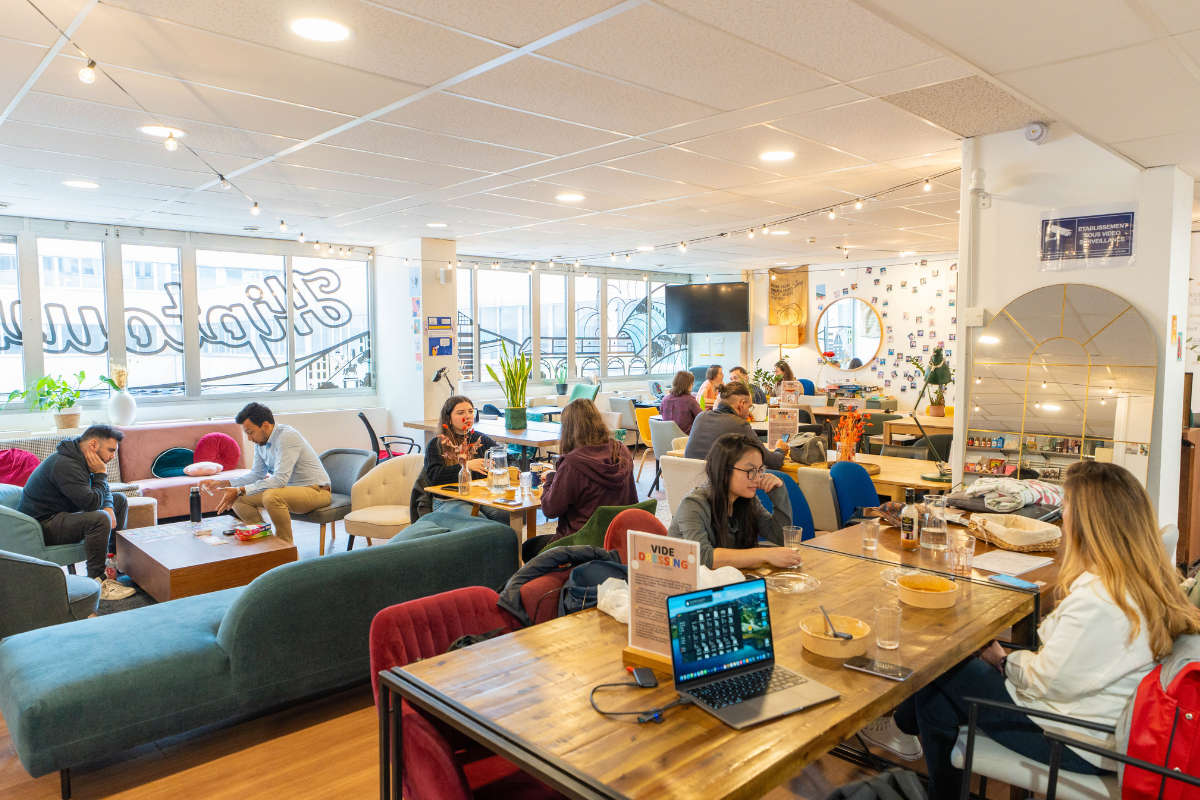
For an SME, choosing office space is rarely just about finding the lowest rent. Two options with a similar price tag can have very different implications depending on the expected occupancy period, the investments required, the services included and the ability to adapt the space over time.
Three initial benchmarks can already help guide the decision. A 3/6/9 commercial lease is generally best suited to stable needs, when the company has good visibility over the next few years and can manage the fit-out and day-to-day running of the premises itself. Coworking with a private office is often more suitable for a small team, a temporary location or a requirement that needs to remain highly flexible. A managed office provides a private workspace while including more services and operational support, usually with a more flexible term than a traditional lease.
Price remains a key factor, but it only tells part of the story. A flexible solution may cost more at first glance while limiting upfront investment or reducing the risk of ending up with space that no longer fits the company’s needs. Offices with a high level of included services can also reduce day-to-day management, provided those services match the company’s actual usage.
This search for balance also reflects wider market trends. In its France Outlook 2026, Cushman & Wakefield notes that financial optimisation remains an important driver of real estate decisions, while companies continue to seek high-quality buildings with a strong level of services. The Spring 2026 managed office and coworking barometer published by Immprove also highlights a model combining flexibility, cost control and services, particularly when companies still have limited visibility over the years ahead.
For an SME, the trade-off ultimately comes down to what the company is paying for and what it gets in return: stability, room to evolve, faster move-in, services or a lower internal management burden.
Key takeaways
A 3/6/9 commercial lease is best suited to stable, long-term requirements, when the SME can anticipate its space needs and organise the premises itself.
Coworking with a private office prioritises flexibility, particularly for a small team, a temporary location or an organisation that is still evolving.
A managed office combines private space, services and flexibility, with most of the day-to-day management handled by the operator.
The monthly price is not enough to make a proper comparison. Fit-out, furniture, service charges, internet, maintenance, additional services and potential exit costs must also be taken into account.
Coworking, a 3/6/9 lease or a managed office: how do they compare?
A traditional lease, coworking with a private office and a managed office can all suit an SME, but they do not offer the same level of stability, personalisation or operational support.
| Criterion | Coworking with a private office | 3/6/9 commercial lease | Managed office |
|---|---|---|---|
| Principle | Private office within a shared workspace | Long-term lease of premises managed by the company | Private workspace with a comprehensive service package and dedicated operator |
| Type of contract | Service agreement | Commercial lease generally entered into for 9 years | Service agreement |
| Commitment period | Short and flexible, depending on the offer | Long-term commitment, with the possibility of leaving at three-year break points depending on the lease terms | Negotiated term, generally more flexible than a 3/6/9 lease |
| Move-in | Office generally ready to use | Fit-out, furniture and installation to organise | Fully equipped offices ready for the team to move in |
| Personalisation | Limited: layout is often standardised | High level of freedom, but financed and managed by the company | Possible depending on the project, the space and the commitment period |
| Shared areas | Reception, kitchen, meeting rooms and social areas are shared | To be created and managed by the company | Private areas, with shared services or communal spaces depending on the site |
| Services | Internet, cleaning, furniture and reception are generally included | Service providers and contracts managed separately | Services grouped under a single contract |
| Meeting rooms | Shared and sometimes subject to usage allowances | Private if included in the fit-out | Private or shared depending on the configuration |
| Day-to-day management | Low* | High: maintenance, cleaning, access, internet and equipment | Largely handled by the operator |
| Upfront budget | Limited, excluding any deposit or additional fees | High: security deposit, fit-out, furniture and installation | Limited to moderate depending on the requested fit-out |
| How to read the price | Monthly price per workstation or per office, with possible extras | Rent plus service charges, taxes, equipment and additional services | More comprehensive and predictable monthly budget, depending on the scope of services |
| Ability to evolve | High if other offices are available on site | Limited by the leased floor area and lease terms | Can evolve depending on available space and contract terms |
| Confidentiality | Private office, but within a shared environment with shared services | Premises fully controlled by the company | Private space allowing for a more independent setup |
| Company identity | Usually limited personalisation | High level of freedom for fit-out and signage | Personalisation possible without having to manage the works directly |
| Best suited to… | Small team, immediate requirement, hybrid working or temporary location | Stable SME with good visibility and the resources to manage its premises | SME looking to combine private space, services, personalisation and flexibility |
*Hiptown manages the dedicated services.
This comparison does not identify one option as universally better than the others. It mainly shows that the level of commitment, day-to-day management and ability to evolve vary significantly from one model to another.
What your office budget is really paying for
The cost of office space only provides part of the picture. Before comparing two options, it is important to understand what the price actually includes and what will need to be financed separately.
Our article on the real cost of office space for teams of 10 or more explores this logic in more detail. For an initial comparison, at least seven cost items should be checked:
- fit-out and move-in: works, layout, moving costs, cabling and commissioning;
- furniture: purchase or rental of desks, chairs, storage and other equipment;
- service charges: building charges, taxes and other expenses included in the contract;
- internet: subscription, installation and network equipment;
- maintenance: cleaning, routine maintenance and repairs;
- additional services: reception, meeting rooms, parking or optional services billed separately;
- potential exit costs: moving, reinstatement works or fees provided for in the contract.
Once this scope is clear, another question becomes useful: what does the company actually gain by spending more?
| Additional spend | What it can provide | It is especially worthwhile if… | Less important if… |
|---|---|---|---|
| More flexibility | Ability to adapt the term, floor area or number of workstations | The requirement is still difficult to predict | The company has strong visibility |
| More integrated services | Less coordination and internal management | Support resources are limited | The company already has its own service providers |
| A ready-to-use setup | Faster move-in and time savings | The timeline is tight | The move can be prepared well in advance |
| Additional capacity | Room to accommodate team growth | Recruitment is genuinely planned | The expected growth remains highly uncertain |
This framework changes the way price should be interpreted. A more expensive offer is not necessarily less attractive if the difference pays for a clearly identified need. Conversely, paying more for flexibility or services that are rarely used may simply increase the overall cost.
An apparent saving can also shift costs elsewhere. A less equipped office may require more preparation; managing several services separately takes time; and a space sized too tightly leaves little room for already planned recruitment.
Internal time does not necessarily need to be converted into a precise hourly cost. The key question is whether the SME has the resources to absorb this organisation. A company that is already equipped and works with reliable service providers may prefer to keep these responsibilities in-house. A business that needs to move quickly may place more value on an integrated solution.
Flexibility: paying for room to adapt, not for flexibility as an end in itself
Flexibility is most useful when it responds to a specific uncertainty.
A company planning several hires, testing a new location, going through a transformation or still stabilising its hybrid working model has less certainty over its future requirements. Being able to adjust capacity, contract length or office configuration can therefore reduce the consequences of getting the initial forecast wrong.
The reasoning changes when activity is stable, headcount is predictable and the location is intended to last for several years. In that situation, a high level of flexibility may be less valuable if it comes at a higher cost.
Flexibility therefore acts as a safety margin, but not every SME has the same risks to cover. If headcount, office attendance, occupancy period or location are still difficult to define, the ability to adapt becomes more important.
For a deeper look at this trade-off, our article on flexible offices versus traditional leases when business visibility is limited explains how commitment level and business visibility affect the decision.
Two Hiptown SME examples: office space that evolves with the business
In Lille, starting with one workstation and scaling with recruitment
An SME specialising in R&D financing and tax consulting, the French subsidiary of a German group, moved into a Hiptown space in Lille when it first entered the French market.
The company started with a single flexible workstation rather than immediately taking a private office that would only have been partially occupied. Within a few months, the team had grown to four employees, with another hire planned after the summer.
The number of workstations was therefore able to grow in line with recruitment, without forcing the company to finance capacity for a team that did not yet exist.
In Lyon, expanding without changing address
A restructuring consultancy, the French subsidiary of an international group, initially occupied part of a Hiptown floor in Lyon.
When an adjacent area became available, the company was able to take it over gradually. Works and reconfiguration were carried out in line with its specifications at each stage, and the company now occupies most of the floor.
In this case, flexibility made it possible to increase the floor area without forcing the company to move. Two different situations, but the same underlying principle: avoiding the need to lock in a space too early when it may quickly stop matching the SME’s actual needs.
Services: distinguishing what saves time from what mainly adds comfort
Services are another important part of the office budget, particularly in managed offices and some flexible workspace offers. Their value depends less on how many are included than on how useful they are to the company.
Furniture already in place avoids an upfront purchase and the logistics that come with it. An operational internet connection reduces the steps required before moving in. Cleaning, maintenance and access management reduce the number of suppliers and contacts that need to be coordinated.
For an SME with limited support resources, an integrated service can therefore provide more than convenience: it reduces the amount of management required around the office. Hiptown’s managed offices are built around this logic, combining a private turnkey workspace with a single service contract.
The benefit still depends on what the company already manages internally. A business with its own equipment, suppliers and established processes may see less value in including certain services.
Other services depend even more heavily on actual usage. Meeting rooms are valuable for a company that regularly hosts clients, but much less so if they are rarely used. The same applies to certain shared spaces, reception services or additional equipment.
An SME can therefore distinguish between:
- services it would have had to pay for anyway;
- services that save time or reduce day-to-day management;
- services that mainly improve comfort and whose value depends on actual usage.
The precise scope should be checked in every offer: “all-inclusive” does not necessarily cover the same services from one operator or site to another.
Which trade-off makes sense for your SME?
Two companies of a similar size may make very different choices. Business visibility, internal resources, timing and even the way the company interacts with clients can all change the priorities.
The table below does not tell you which office model to choose. Instead, it highlights where additional spend may make the most sense depending on the situation.
| Company situation | Priority to assess | What may justify a higher budget |
|---|---|---|
| Stable headcount and well-defined requirement | Long-term cost control | Right-sized space and a stable framework |
| Growth or change that is difficult to predict | Ability to adapt | Flexibility in term, floor area or number of workstations |
| Limited internal resources for office management | Operational simplicity | Integrated services and fewer suppliers to coordinate |
| Need to move in quickly | Implementation time | Furniture, internet and equipment already operational |
| Regularly hosting clients or partners | Quality of use | Suitable meeting rooms, confidentiality, reception and overall image |
| Location still being tested | Reversibility | Limited commitment and the ability to adapt the solution |
| Hybrid working model still evolving | Capacity adjustment | A solution able to adapt to changes in office attendance |
Priorities can of course overlap. A new location may require both flexibility and a fast move-in. A company that regularly hosts clients may decide to allocate more of its budget to location, meeting rooms and confidentiality, even if headcount changes very little.
The same additional euro therefore does not create the same value for every SME.
Six questions to ask before choosing office space for an SME
Before making a decision, six questions can help bring the comparison back to the company’s actual needs.
1. How much of our current requirement is likely to remain valid in 18 or 24 months?
Headcount, attendance patterns, location and team organisation: the more of these factors remain uncertain, the more useful an adaptable solution may be.
2. What will need to be added to the advertised price?
Fit-out, furniture, internet, service charges, maintenance, moving costs and additional services should all be included when comparing equivalent scopes.
3. What would we be willing to pay more for?
Moving in quickly? Being able to expand? Reducing management? Improving reception or confidentiality? Any price difference should correspond to a clear business priority.
4. Which services will we actually use?
A frequently used service that replaces an expense or recurring task should carry more weight than an option that is rarely needed.
5. How much of our office organisation do we want to manage ourselves?
Some SMEs prefer to keep their own equipment and service providers; others choose to delegate more so they can focus internal resources elsewhere.
6. What happens if our original scenario changes?
A team growing faster or slower than expected, or a change in office attendance, will not have the same consequences under every contract. The harder a change would be to absorb, the more valuable flexibility may become.
Allocate your office budget according to the company’s priorities
When the time comes to decide, the office budget does not simply show how much an SME can spend. It also reflects what the company chooses to secure: a long-term location, the ability to adapt its office space, a fast move-in, less internal management or better conditions for welcoming clients and teams.
Two companies with a similar budget may therefore reach different conclusions. One may accept a higher monthly cost to remain mobile. Another may prefer to invest in premises it can control fully over several years. A third may choose a more integrated solution to avoid spending internal time on the day-to-day running of its offices.
Price then becomes a decision-making tool: where does additional spend genuinely make the SME easier to run, and where can it be reduced without creating a new constraint?
Talk to our team to identify the right office solution for your SME.