

Choosing the location of your offices often begins with an area you already know: a central district, a prestigious address, a well-connected neighbourhood or a location close to the directors’ homes. These criteria may be relevant, but they are not enough to determine whether the offices will genuinely be convenient for the whole team.
An address in the city centre may require several changes for some employees. Conversely, a slightly less central location may provide more direct journeys, better access to train stations or a simpler daily routine. Door-to-door journey time, transport reliability, the number of changes and how often people come into the office often matter more than distance alone.
The aim is not to find a perfect address for every employee. Such a location rarely exists when team members live in very different areas. The task is instead to identify a sufficiently balanced centre of gravity that does not place a lasting burden on one part of the team and remains consistent with the company’s needs.
Clients, partners, business travel, future recruitment and the available budget must also be included in the analysis. A highly accessible area may offer few suitable offices. Another may appear more attractive financially but make collective office days more difficult.
Before comparing buildings or arranging viewings, it is therefore better to start by comparing areas. This preliminary work also helps companies avoid mistakes when searching for office space, particularly when an appealing address begins to outweigh the team’s actual needs too early in the process.
Key takeaways
Convenient offices are not necessarily the most central or the closest to the homes of a few decision-makers. They should provide an acceptable compromise for the whole team.
Geographical distance alone is not enough to assess a location. Actual journey time, changes, transport reliability and the final part of the journey often matter more.
Office attendance patterns must also be considered. A demanding commute does not have the same impact when an employee comes in once a week as it does when they travel to the office four times a week.
Finally, average journey times may conceal particularly difficult situations. The longest or most complex commutes should be examined separately.
A convenient office location is not simply a central address
A central address is often reassuring at the beginning of an office search. It is familiar, easy to locate and may strengthen the company’s image among clients or candidates. However, this centrality remains theoretical until it is compared with the journeys the team will actually make.
Two addresses only a few stops apart may be very unevenly accessible depending on the lines and connections used by employees. The first may be immediately next to a metro station but require two changes for part of the team. The second may appear less central while offering direct links to several residential areas or a major train station. In everyday use, the difference may amount to several dozen minutes and greater uncertainty.
Proximity should therefore be assessed across the entire journey. This means considering the time required to reach the departure station, any changes and waiting time, followed by the walk between the final stop and the office. A direct line followed by a few minutes on foot may be more comfortable than an address in the heart of the city that can only be reached after several changes.
This analysis does not mean ruling out central districts, but checking what they offer in practice. A location may remain relevant if it makes train stations, client meetings or business travel easier to access. A prestigious address, on the other hand, loses some of its value if it makes collective office days considerably more difficult.
This approach can then be applied to a particular city, for example when choosing an area in Lille based on the company’s needs rather than on reputation alone.
Three concepts should be distinguished before selecting an area:
- geographical proximity, measured in kilometres;
- time-based proximity, linked to the actual duration of the journey;
- the simplicity of the commute, which depends in particular on changes and transport reliability.
A slightly longer but direct and predictable journey is sometimes better accepted than one that looks shorter on paper but is unreliable.
Map departure points and office attendance days
Once the search area has been widened beyond the city centre alone, the next step is to examine where the team actually travels from. The aim is not to draw a detailed map of every home address, but to identify the main departure areas: towns, districts, train stations or local stations commonly used.
The information collected can remain simple. In most cases, a postcode, town or reference station is enough to identify the main patterns. Asking for complete home addresses would often be unnecessary. The objective is to understand the team’s geographical distribution, not to know exactly where everyone lives.
The resulting map will rarely reveal an obvious central point. Part of the team may live to the east of the city, another part in the nearby suburbs, while several employees arrive through the same train station. Rather than looking for a geometric midpoint, the company should identify shared transport routes, areas that can be reached without a major detour and locations that limit the most demanding commutes.
Office attendance days should be included from this stage onwards. Someone who comes into the office four times a week does not experience the same level of constraint as an employee who attends occasionally. The journeys of less frequent users should not be ignored, but they cannot be weighted in exactly the same way.
A very simple table is enough to guide the search:
- departure area or station;
- number of employees concerned;
- usual office attendance frequency;
- direct journey or journey requiring changes;
- any known specific constraints.
This overview may reveal that an apparently balanced address requires several changes for a significant group, or highlight an area that is better connected from several directions.
It is better to work with groups rather than individual cases. Three or four broad commuting profiles are generally enough to narrow the search down to a few plausible areas.
Compare real journeys, not kilometres
Once a few areas have been identified, the comparison should focus on journeys as people will actually experience them. Two locations at a similar distance may result in very different commutes depending on the lines used, changes, waiting times or the amount of walking required at the destination.
The calculation should be made door to door, at the usual travel times. A journey advertised as taking thirty minutes may become longer when someone has to reach a train station, wait for a connection or walk the final kilometre. Conversely, a more distant address may remain comfortable if it offers a direct link from the main departure areas.
Depending on the city, cycling can also change how a location is assessed. An address with weaker metro connections may still be easy to reach along a direct cycle route. The safety of the journey and the facilities available on arrival should then be checked: secure parking, a bicycle room, changing rooms or showers.
The number of changes deserves particular attention. Every connection adds a risk of delay and reduces the predictability of the journey. This becomes more significant when lines are heavily congested or services are infrequent. Saving a few minutes on the theoretical journey time rarely compensates for an unreliable commute that varies considerably from one day to the next.
For each area under consideration, it is enough to assess:
- the median journey time;
- the number of employees with a direct journey;
- the average number of changes;
- the frequency and reliability of the services;
- walking time at the start and end of the journey;
- the quality of cycling access and the facilities provided in the building;
- whether there is a reasonable alternative route.
The immediate surroundings of the address should also be examined. A nearby station does not guarantee smooth access if the exit is poorly located or the building entrance remains some distance away. Testing the route at the usual travel times helps identify details that mapping tools do not show clearly and distinguish between a few credible areas.
As an example, this map compares transport accessibility for six workspaces located in Bordeaux, Lille, Rennes, Paris, Marseille and Lyon.
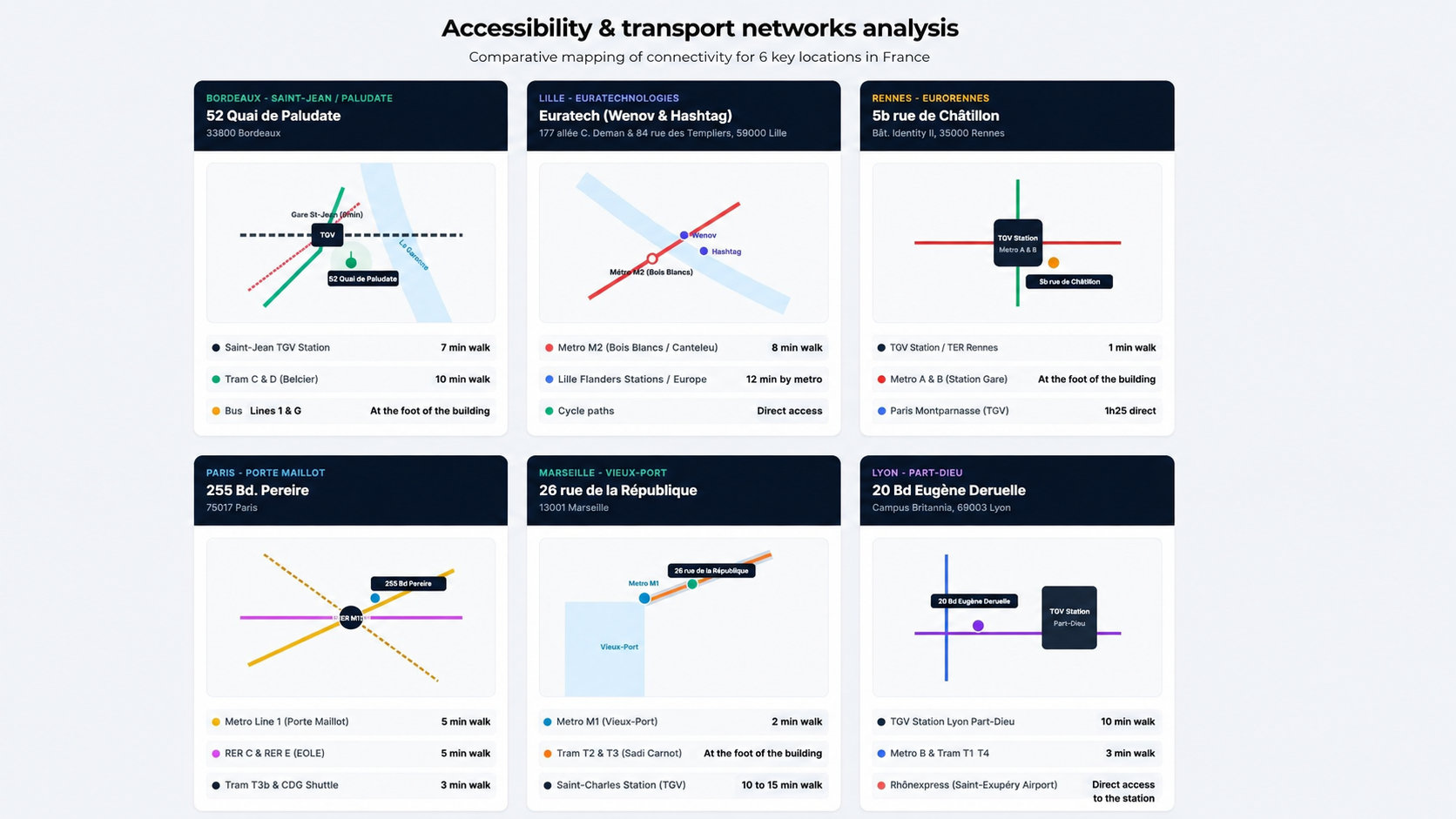
Click the image to view the transport networks and access times in detail.
Also examine the most difficult commutes
An acceptable average may conceal significant differences. If a location slightly reduces the journey time for most employees but requires a significant group to travel for more than an hour with several changes, the decision deserves to be reconsidered.
The median should therefore be supplemented by an assessment of the most extreme situations. How many employees would face a journey time that would be difficult to sustain? How many would depend on a single line with no alternative? Would certain groups be consistently disadvantaged on collective office days?
Home locations, modes of transport and personal constraints make perfect equality impossible. The company can nevertheless avoid choosing a location that creates a lasting difficulty for part of the team.
Office attendance frequency also adds nuance to the analysis. A longer journey may remain acceptable for someone who attends occasionally, whereas it becomes far more demanding when repeated several times a week. This weighting should remain easy to understand and should not turn into an excessively detailed calculation for each individual.
A simple classification helps make the results easier to read: direct or predictable journeys, journeys that are acceptable despite a moderate constraint, and finally difficult journeys when they combine duration, changes or a high degree of uncertainty.
An area may have an acceptable average journey time while still creating too many difficult situations. The comparison should therefore highlight the most demanding commutes and check whether the burden is consistently placed on the same group of employees.
Look at what the neighbourhood makes easier day to day
Once employees arrive, the local environment and services within walking distance also influence their office days. A varied choice of places to eat within a few minutes of the office makes lunch breaks easier. Everyday shops, a gym, green spaces or a nursery may also help employees organise their day and make the neighbourhood more attractive.
Their importance depends on office attendance patterns and how accessible they are in practice. During viewings, a quick walk around the area helps confirm the lunch options, useful shops, pedestrian routes and the atmosphere at arrival and departure times.
Include clients, recruitment and business travel
Employees’ home-to-work journeys are the starting point of the analysis, but they are not the only movements to consider. Depending on the company’s activity, the offices may also regularly welcome clients, partners, candidates or employees travelling from other cities.
Proximity to a train station may become decisive for a company whose teams travel frequently. Paying more for a highly central address may be less justified when external meetings are rare and most work is carried out remotely.
Future recruitment should also be considered in a measured way. Without attempting to predict where every new employee will live, the company can examine the relevant talent pools, schools and transport networks used by the profiles it hopes to recruit. A location that is difficult to reach from these areas may reduce the available recruitment pool.
These criteria become particularly important when choosing offices for a subsidiary in Paris or elsewhere in France, when the team is still likely to evolve and maintains regular links with the head office.
The different journeys should be ranked according to their actual frequency. Daily or weekly journeys will generally carry more weight than occasional visits. A location should not be selected to make a monthly meeting easier if it makes the team’s weekly commute more difficult.
Adjust priorities to the company’s profile
The company’s size and organisational model often change the order of priorities, without replacing an analysis of its actual activity and office attendance patterns.
| Profile | Common priorities | Point to watch |
|---|---|---|
| Entrepreneur or small business | Convenience for the founder, client meetings, a controlled budget and useful day-to-day services | Do not pay for centrality that is rarely used |
| Growing startup | Recruitment, flexibility, access from several residential areas and room to grow | Avoid choosing an address that only suits the current team |
| SME | A balance between employee commutes, client access, cost and stability | Do not underestimate differences in journey times within the team |
| Large company or multi-site organisation | Access to train stations, connections between sites, visitor capacity and business travel | Include business travel as well as home-to-work journeys |
Balance accessibility, budget and the quality of available offices
Once the most accessible areas have been identified, the property search can begin within a more clearly defined perimeter. It then becomes easier to compare available Hiptown spaces according to the city, the type of office required and the number of people to accommodate.
An area that works well for the team may offer few offices matching the required size, budget or service level. Another may provide immediately operational space with slightly less favourable commutes. The decision then depends on what the company actually gains from each location.
The full cost should be considered. Lower rent may lose some of its appeal if the space requires building work, furniture, technical installation or more day-to-day management. A solution that initially appears more expensive may still be relevant if it is ready to move into, correctly sized and flexible enough to support the team’s development.
The location should also be considered in relation to office attendance patterns. For a team that meets several days a week, straightforward journeys will carry considerable weight in the decision. When the office is mainly used for occasional team gatherings, the company may sometimes accept a slightly less balanced area in exchange for a space that better supports those uses.
Comparing two or three locations with the same assessment framework prevents one criterion from gradually taking too much importance during the viewing process.
| Criterion | What to assess | Point to watch |
|---|---|---|
| Team commutes | Median journey time, changes and the most difficult commutes | Do not rely on the average alone |
| Office attendance | How often different teams travel to the office | Avoid an overly complex individual weighting system |
| Clients and visitors | Access from train stations, public transport and main road routes | Relate this criterion to the actual frequency of visits |
| Available offices | Floor area, layout, privacy and services | An accessible area does not compensate for unsuitable office space |
| Overall budget | Rent, service charges, fit-out, equipment and management | Compare solutions offering an equivalent service level |
| Team development | Capacity to accommodate recruitment or a change in attendance patterns | Do not oversize the offices based on uncertain assumptions |
Before confirming an address, a few on-site checks remain useful. Travelling the route at the usual times, observing the exit from the train or metro station, measuring the walk to the building and reviewing alternative routes in the event of disruption provide a more accurate understanding of the location.
This step may reveal a street that is difficult to access, an entrance some distance from the station or a return journey that becomes less straightforward at the end of the day. These details do not determine the decision on their own, but they help avoid unpleasant surprises after moving in.
Choose a location that remains workable over time
Offices close to home cannot mean the same thing for every member of a team. The aim should therefore be to find an area that distributes the constraints reasonably and makes the days when employees need to meet easier to manage.
The process combines departure points, office attendance frequency, the most difficult journeys, neighbourhood services and business travel. It should lead to acceptable accessibility, suitable offices, controlled costs and a sufficiently flexible organisation that can evolve with the company.
Comparing areas before individual addresses allows the company to focus viewings on credible options and choose a location that will remain convenient once the team has moved in.
