
Where will we be working in a year, and in three years? For a fast-growing company, the answer is rarely clear. Yet a standard lease requires a commitment spanning several years.
This is the situation Alma, the French leader in installment payments, experienced in Lille. The company opened its Lille office with Hiptown in July 2021. At that time, it had 7 employees. Today, there are more than 90.
Here’s how the company has adapted its offices as it has grown, and how that affects day-to-day operations.
A long-term Commitment in the face of changing needs
When it came time to expand its office, Alma received offers for commercial leases of 3, 6, or 9 years. The problem wasn’t the price. It was the inability to plan ahead.
“Even three years out, it was hard to anticipate our needs. What mattered to us was being able to adapt our office as our business grew.”
Édouard, Customer Operations Manager at Alma
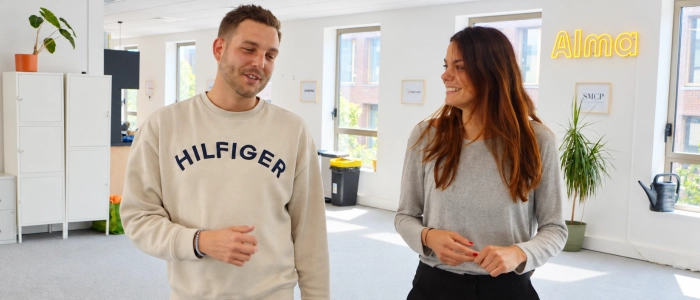
Watch the video featuring Édouard, Customer Operations Manager at Alma, sharing his story
Signing a lease for a space that’s too small forces you to move quickly. Signing a lease for a space that’s too large means paying for empty square meters. In both cases, the company faces a risk it cannot control. For a team that grows from a few people to several dozen in a short period of time, this risk becomes very real: a lease signed for 7 people is no longer suitable six months later.
A commercial lease of 3, 6, or 9 years establishes a framework over long periods. This is an advantage when business is stable and you know your needs. It becomes a constraint when the workforce doubles in a year, teams restructure, or the company expands into new business areas.
For Alma, the priority was therefore to find a framework that accommodates uncertainty, rather than simply gaining a few square meters. That was the deciding factor. Flexibility is what convinced Alma to choose Hiptown.
From 7 to 90 employees: Alma’s growth supported by Hiptown
| Period | Headcount | What’s Happening |
|---|---|---|
| July 2021 | 7 people | Alma opens its Lille office at Hiptown Euratechnologies |
| 2022 | The team grows from 20 to 40 people | Move to a new floor within the same building |
| 2023 | More than 90 employees | Move to a larger, custom-designed office |
Alma’s workforce has grown nearly thirteenfold. The flexibility of Hiptown’s offerings allowed the company to move to a new location in 2023, with support from the site team at every stage of its development.
What Alma’s trajectory shows
Needs change in nature, not just in scale. Growing from 20 to 40 people, then to more than 90, requires a different organizational structure: more meeting rooms, common areas, and a different flow of traffic.
It’s not always possible to plan ahead, and Alma couldn’t have predicted in 2021 what its headcount would be in 2023. A framework that allows for growth protects against this uncertainty. The workspace also matters to teams. Beyond price and square footage, it’s the quality of the workspace on a day-to-day basis that employees notice first.
What flexibility has made possible in practice
In 2023, following significant growth in its workforce, Alma moved to a space with capacity for about 100 workstations. The site team closely oversaw this change in size: everything was customized as part of a bespoke solution, rather than simply moving into a space that was delivered “as is.”
The layout of the workspaces is designed to serve specific purposes. On one side, the company now has four meeting rooms and a common area with a kitchen. On the other side, all the offices are organized as an open-plan space, complemented by smaller meeting rooms. The Alma teams say they are now very satisfied with these offices, which have been customized to meet their needs.
Delegated mental load
Managing an office takes time—often more than you might think. You have to keep track of energy and internet contracts, ensure that the air conditioning and heating are working properly, restock everyday supplies, and find the right person to contact whenever something unexpected comes up. All of these tasks combined represent a real mental burden for a team whose job isn’t to handle them.
For a rapidly growing team, this factor carries more weight than it might seem. Every management task that the company doesn’t have to handle itself frees up time for its core business and prevents an office manager or manager from having to manage contractors instead of their team.
Support, not just a place to work
Beyond the office space, it’s the on-site team that makes all the difference for Alma’s teams. They’re available throughout the day—via WhatsApp or Slack—and respond quickly. They also send managers an end-of-week recap of office life and share information about events organized at the site or in the Lille metropolitan area.
“When our colleagues from Paris come here, the first thing they say to us is, ‘Wow, you’ve got it so good in this office!’ For us, that’s truly a mark of quality. But beyond the walls, what really makes the difference is the Hiptown team. It’s all in the details.”
Édouard, Customer Operations Manager at Alma
The quality of an office isn’t just about its size. It also depends on how requests are handled on a day-to-day basis. Alma’s teams appreciate that the on-site team seeks solutions to their needs—beyond simply providing workstations—and they don’t feel like just another client.
This relationship becomes particularly important when relocating. A move requires determining the number of workstations, allocating meeting rooms, common areas, and open-plan spaces, coordinating the layout, and organizing the transition from one location to another. For a growing company, these tasks often coincide with hiring, without there always being a dedicated team to handle them.
Hiptown assists with relocations and designs custom spaces. At Alma, this resulted in a customized space in 2023—rather than one delivered “as-is”—with a layout tailored to the company’s needs.
Having a point of contact who is already familiar with the company also means you don’t have to start from scratch. There’s no need to re-explain requirements at every stage, and the new space can build on how the old one was used. A change in workspace is still a project that requires planning, but it becomes easier to prepare for when the context is already shared.
How do you know if a flexible plan is right for you?
Alma’s situation doesn’t apply to all companies. A traditional lease is still a good option when the workforce is stable and you want to customize your space from top to bottom. Depending on the company’s stage of growth, Hiptown offers private offices starting at 2 workstations and self-contained office floors starting at 10 workstations.
In other cases, five questions can help you decide.
- Can you predict your headcount two or three years from now? If the answer is no, avoid long-term commitments. Rapid growth or a business undergoing transformation makes forecasts unreliable.
- Does your site offer spaces of different sizes? This allows you to expand without changing your point of contact and without having to start from scratch in your search for space.
- Can you adapt the space to your needs? Meeting rooms, common areas, open-plan offices—not everything can always be modified. It’s best to know this before you sign.
- Who handles day-to-day operations? Services, utilities, internet: it’s best to know what’s delegated and who to contact if a problem arises.
- How can you reach the team when needed? Responsiveness is measured by the communication channels used on a daily basis and by actual response times.
Are you expecting significant growth in your teams? Contact Hiptown to find a space that can grow with you, no matter what your needs may be.


