

Booking bedrooms and a meeting room for the same dates is not enough to organise a seminar with accommodation. Difficulties often arise between the different services: a bedroom that is not available when the train arrives, luggage that participants have to carry to the first meeting, a workshop without a suitable space, or a hotel that is convenient for sleeping but poorly equipped for working.
On a small scale, these mismatches remain manageable. They become more disruptive when thirty employees arrive from several cities, split between a plenary session and working groups, then leave at different times. An arrangement that runs smoothly for ten people can quickly involve several contacts and require a succession of adjustments for a larger group.
The programme therefore needs to be considered as a continuous journey: arrival, luggage drop-off, meetings, workshops, breaks, meals, accommodation and departure. Each stage may work perfectly well on its own while creating, once combined with the others, a complicated journey for participants.
The choice of venue also depends on the nature of the gathering. An executive meeting followed by one night in a hotel does not require the same spaces as a project team working together for three days. A meeting room within the hotel may sometimes be perfectly suitable. For the simplest formats, the criteria remain similar to those used to choose a meeting room or the right venue for an event. As soon as the programme becomes more varied, however, the entire arrangement needs to be assessed.
In other cases, private offices, several workspaces or a separate professional venue will provide better conditions.
A seminar with accommodation does not necessarily become simpler because all the services are located in a single establishment. It becomes smoother when the workspaces, bedrooms, meals and travel arrangements have been designed as one continuous journey.
Key takeaways
The working programme should be defined before the hotel and workspaces are booked. Headcount alone does not tell the whole story: the required room layouts, simultaneous workshops and confidentiality needs can significantly change the arrangement.
Bringing accommodation and meetings together in one place reduces travel, but does not guarantee suitable working conditions.
Offices become useful when the seminar includes several different activities: small-group work, calls, interviews, video conferences or the continuation of day-to-day operations over several days.
Proximity needs to be assessed in real conditions. Timings, luggage, accessibility, the frequency of journeys and the simplicity of the route matter more than a distance displayed on a map.
Finally, allowing some flexibility in headcount, timings and amendment conditions prevents a limited change from forcing the entire plan to be reconsidered.
Define the seminar format before looking for a venue
The expression “seminar with accommodation” covers several quite different formats.
In a residential seminar, bedrooms, meals and meetings are brought together in a hotel or estate. The group shares most of the programme and travels very little.
A semi-residential seminar combines a hotel with offices or meeting rooms located nearby. This format provides a wider choice of professional spaces, but requires precise coordination between the two venues.
Other gatherings are closer to an extended working session. A project team, several departments or employees from different sites come together for two or three days to produce work, make decisions and move a project forward. The programme then alternates between group meetings, small-group work, calls and periods of focused work.
These three formats cannot be planned in the same way. A room designed for twenty people may accommodate a plenary session without difficulty. It becomes insufficient if three workshops need to take place at the same time, some participants are joining a video conference and a confidential interview is scheduled concurrently.
Attendance schedules matter as much as the overall headcount. A group that arrives the evening before and leaves together creates few movements. Participants attending at different times require greater flexibility in terms of access, meals, bedrooms and the circulation of information.
The pace of the programme deserves the same attention. Scheduling too many sessions, room changes or journeys leaves little room for informal conversations or delays. Allowing a few breaks in the schedule often makes the programme more realistic and easier to maintain when a session runs over.
Before checking availability, several points therefore need to be clarified:
- will participants remain together or work in several groups?
- which discussions require a private room?
- will some employees need to continue taking their usual calls or attending appointments?
- will the same rooms be used throughout the stay?
- will arrivals, meals and departures take place at the same times?
Once these questions have been answered, the requirements become clearer: the number of rooms, the usefulness of additional offices, the equipment needed and the expected proximity between the hotel and the professional spaces. The search therefore starts with the work to be completed, rather than with the venues available.
Combine all services or separate the hotel from the workspace?
An all-in-one hotel is a coherent solution when the programme follows a simple structure: one main room, a few group sessions and participants who move through the schedule together. Everyone has a single reference point for sleeping, working and eating.
This geographical convenience does, however, have its limits. Some hotel meeting rooms are suitable for a presentation, but less well adapted to simultaneous workshops, a demanding video conference or confidential discussions. Lobbies and shared lounges do not always replace a private office. It may also be difficult to leave equipment set up between two working days.
Separating the accommodation from the workspace provides more options. Fully equipped meeting rooms and dedicated professional spaces make it possible to choose a layout based on the programme rather than solely on the hotel’s capacity: a large room, private offices, breakout areas, equipped workstations or spaces available throughout the day.
This option remains simple for participants when the route is direct and responsibilities are clearly assigned. It is particularly well suited to:
- workshops taking place in parallel;
- executive committees and sensitive meetings;
- teams that need to continue handling operational matters;
- hybrid sessions or video conferences;
- programmes extending over several working days.
| Configuration | Main advantage | Limitation to anticipate | Most suitable use |
|---|---|---|---|
| Hotel with integrated meeting rooms | Very little travel | Choice of spaces may be limited | Collective, linear programme |
| Hotel close to professional meeting rooms | Better-equipped meetings | Coordination between two venues | Structured workshops or meetings |
| Hotel combined with offices and meeting rooms | Complete working environment | Participant journey must be planned carefully | Team working together for several days |
| Several hotels around one central venue | Greater accommodation capacity | More complex rooming lists and arrivals | Large group or dispersed hotel availability |
Centralising the organisation does not necessarily mean concentrating everything in one building. Coherence comes instead from a clear programme, spaces suited to each stage and a journey that participants can follow without constant assistance.
When one room is not enough: think in terms of a temporary working environment
A main room is suitable for a presentation, training session or group meeting. Requirements change as soon as several activities need to take place at the same time.
Some participants may need to prepare a presentation while another group continues a workshop. An executive team may need privacy to make a sensitive decision. Employees may still have client calls or need to connect with a team working remotely. Equipment used over several days may also need to remain set up and secure.
In this situation, the number of simultaneous configurations becomes a better indicator than the total number of people.
A temporary working environment may combine:
- a plenary room;
- several breakout spaces;
- a private office;
- a few equipped workstations;
- a break area separated from spaces intended for focused work.
When the team needs a private base for several days, ready-to-use managed offices can also bring together workstations, meeting rooms and services in a more stable environment, depending on the duration of the requirement and availability.
The aim is not to accumulate rooms. The main priority is to prevent an important activity from being relegated to a corridor, lobby or improvised room at the last minute.
Technical requirements follow the same logic. A standard presentation requires little equipment. A hybrid session spread across several spaces requires a stable connection, screens in secondary rooms, compatible cables and adapters, and technical support if a problem occurs.
Testing the equipment before the group arrives makes it possible to check the internet connection, video conferencing system, sound and different cables and adapters. This is particularly useful when several rooms are operating in parallel or when participants are joining remotely.
The prestige of the venue then matters less than its ability to support the programme. A simple, well-configured space that remains available throughout the day will often be more effective than an impressive setting that is poorly suited to the work involved.
Plan the participant journey from arrival to departure
The first meeting is not the true starting point of the seminar. For participants, the journey begins at the railway station, airport or car park.
It continues with luggage drop-off, access to the spaces, movement between rooms, meals, the journey to the hotel and finally the collection of belongings before departure. Each transition takes little time when it has been planned. When overlooked, it slows the group down and forces the organiser to intervene repeatedly.
The distance between the hotel and the workspace needs to be assessed in real conditions. A direct ten-minute walk is generally easy to manage. The same amount of time becomes more restrictive with luggage, several changes of direction, a late arrival or poor weather.
The frequency of journeys also changes the equation. Leaving the hotel in the morning and returning in the evening remains easy to manage. Repeated journeys between bedrooms, meetings and meals break up the programme to a greater extent.
Hotel timings create another point to consider. Participants arriving in the morning may not be able to access their rooms immediately. On the final day, they will often need to check out before the sessions end. Luggage storage at the hotel or a secure storage area at the workspace prevents suitcases from being carried around the meeting rooms.
Catering deserves the same level of attention. A lunch venue located too far away can considerably reduce the available break. Dietary requirements communicated too late limit the available solutions. Not every meal needs to take place on site, but its location and duration must remain compatible with the planned schedule.
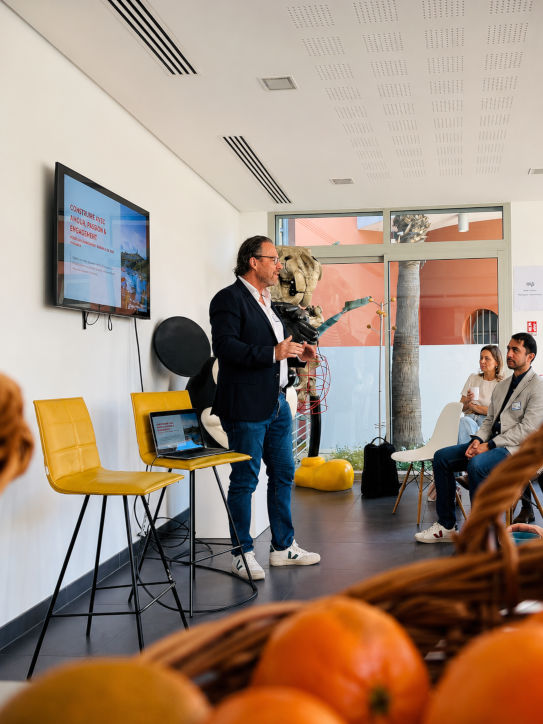
Informal moments should also have a place in the participant journey. A lunch, buffet, drinks reception or time on a terrace can encourage informal discussions and allow conversations to continue in a less formal setting. Location matters as much as format, however: an attractive terrace or rooftop located too far from the meeting rooms and hotel may add a journey that is difficult to accommodate. When these spaces are available on site or very close by, they can support team cohesion without making the day more complicated.


Check accessibility throughout the entire journey
Accessibility cannot be assessed establishment by establishment. A hotel with accessible bedrooms does not solve the problem if the route to the meeting rooms includes obstacles.
The assessment should cover:
- arrival from the railway station, car park or drop-off point;
- entry into the professional spaces;
- movement between different floors;
- access to toilets and meals;
- the journey to the bedrooms.
Depending on the participants, other arrangements may be needed: clearer signage, a hearing assistance system, a lift, additional travel time or consideration of specific dietary requirements.
A genuinely accessible event should not depend on improvised adjustments once the group has arrived.
Clearly assign responsibilities among the different providers
Several providers can contribute to the same seminar without making it difficult to manage. Problems arise mainly when each party holds only part of the information and no one retains an overview of the entire arrangement.
The hotel will generally manage the bedrooms, breakfasts, arrival and departure times, luggage storage and incidental charges. The professional venue manages the offices, meeting rooms, layouts, equipment and access. Transport, some catering services and group activities may be handled by additional providers.
The company, meanwhile, centralises the programme, participant lists, specific requirements and last-minute changes.
This coordination role should not remain implicit. One identified person within the company should retain a complete overview of the arrangement and ensure that every change is communicated to all the providers concerned. Adding one participant may simultaneously affect a bedroom, access badge, meal, seat in a vehicle and the capacity of a room.
The rooming list sent to the hotel should be monitored carefully: attendance dates, late arrivals, specific requests and any additional nights. The meeting venue does not always require the same information, but headcounts and timings need to remain consistent.
The role of a professional workspace operator primarily concerns the offices, meeting rooms and on-site services. The booking of bedrooms, transport or additional activities may remain separate, depending on the city, project and partners involved.
Centralisation depends less on using one provider than on reliable information, an identified coordinator and a clear process for managing changes.
Assess the budget for the entire stay
The price of a bedroom, meeting room or meal is easy to compare. Considered separately, however, these figures provide an incomplete picture of the budget.
Secondary spaces, technical equipment, transfers, luggage storage or extended access hours may be added to the initial quotation. A cheaper but more distant hotel may require several paid journeys. A meeting room with limited flexibility may result in a second space being hired for a few hours.
| Category | Items to include |
|---|---|
| Accommodation | Bedrooms, breakfasts, local tourist tax, additional nights, amendments |
| Professional spaces | Main room, offices, secondary spaces, access hours |
| Technology | Screens, video conferencing, sound equipment, cables and adapters, technical support |
| Catering | Breaks, lunches, dinner, deliveries, specific dietary requirements |
| Travel | Train travel, transfers, taxis, parking, journeys between venues |
| Services | Reception, luggage storage, signage, clearing and storage, additional staff |
| Contingencies | Additional participant, extended hours, room change, postponement or cancellation |
This approach makes it possible to compare proposals with different scopes. A room that includes equipment, reception and refreshments cannot be assessed in the same way as a bare room hire. A hotel within walking distance of the offices may also offset a slightly higher rate by removing the need for daily transfers.
Coordination time is another cost, even though it does not appear in quotations. Managing bedrooms, rooms, equipment, meals and travel separately requires internal resources. A more structured proposal may therefore be more economical when it reduces interventions and last-minute changes.
To make this initial estimate easier, Hiptown provides an Excel budget template to complete. It can be used to enter quantities and unit prices, calculate totals for each category and include a contingency allowance.
Download the seminar budget template
Test the plan against a few realistic changes
Before confirming the bookings, it is useful to run through the stay as planned and then consider a few plausible variations.
The programme runs as planned
Can participants leave their luggage before the meeting? Will the rooms be open when they arrive? Do the breaks leave enough time to move between spaces? Is the journey to the hotel still straightforward at the end of the day?
This exercise often reveals very practical inconsistencies that a theoretical schedule does not show.
Attendance increases or decreases
A few cancellations or late registrations affect bedrooms, meals, access arrangements and sometimes room layouts. Deadlines for making changes therefore need to be known, together with any additional charges.
Booking to the exact expected requirement reduces the initial cost, but leaves little flexibility. Conversely, oversizing every service unnecessarily increases the budget. Some items can be secured early, while others remain adjustable until an agreed date.
Times or dates change
A delayed arrival, cancelled train or extended meeting should not require the entire arrangement to be redesigned.
Late-arrival procedures, the possible extension of room access, luggage storage, the addition of an extra night and postponement conditions should be identified in advance. It is also useful to know which contacts can be reached outside normal working hours.
A robust plan does not anticipate every possible incident. It simply retains enough flexibility to prevent a limited change from disrupting the entire stay.
Three sample programmes, three different needs
Ten-person executive committee over two days
The priorities here are confidentiality and a stable setup. A private meeting room, an additional office and reliable video conferencing equipment may be sufficient. A nearby hotel makes the stay easier without requiring strategic discussions to take place in shared hotel areas.
Thirty-person seminar with simultaneous workshops
The group first meets in a plenary session, then divides into several rooms. The secondary spaces need to be available at the same time and offer consistent equipment. Reception, signage and luggage management become more important because each transition involves several dozen people.
Project team together for three days
The gathering is closer to a temporary workplace setup. The team needs a base that remains accessible throughout the day, rooms that can be used as meetings arise, equipped workstations and private areas for essential calls. Offices combined with several meeting rooms are often more functional than an event space booked for a few individual time slots.
The right format therefore depends less on the name given to the seminar than on the work that actually needs to be completed during the stay.
Mini checklist before confirming the bookings
Programme and spaces
- Are the daily schedules sufficiently stable?
- How many groups will be working at the same time?
- Are offices or private spaces required?
- Has time been allowed for setup and clearing?
- Is the equipment suitable for the presentations, workshops and video conferences?
Participants and accommodation
- Do the bedroom bookings match the participants’ actual attendance dates?
- Has the choice between single and double rooms been confirmed with the participants concerned?
- Have late arrivals and early departures been identified?
- Who sends and updates the rooming list?
- Have accessibility needs and dietary requirements been collected?
- Can luggage be stored before check-in and after check-out?
- Are personal incidental charges separated from expenses covered by the company?
Travel and meals
- Has the route between the hotel and the workspaces been tested?
- Is it still practical with luggage and for every participant?
- How many return journeys are planned during the day?
- Do the meals fit within the session schedule?
- Is a transport or contingency solution required?
Coordination and changes
- Has a central coordinator been appointed?
- Is there an identified contact for each service?
- Until what date can attendance numbers be adjusted?
- What conditions apply to a cancellation or postponement?
- Can the spaces remain accessible if a meeting runs over?
- Who should be contacted if a problem occurs on the day?
This final check confirms that the bookings form one coherent arrangement and that important information is not scattered among several contacts.
Make the logistics disappear behind the programme
A seminar with accommodation works when participants can focus on discussions, decisions or the work to be completed, without having to resolve questions about travel, luggage or access themselves.
An all-in-one hotel is an effective solution for some programmes. For multiple workshops, confidential meetings or several working days, combining nearby accommodation with suitable offices and meeting rooms can provide a more functional setting.
The success of the arrangement then depends on a few simple factors: spaces aligned with the intended uses, a practical participant journey, clearly assigned responsibilities and enough flexibility to absorb a change.
Coordination has been successful when the offices, meetings and hotel no longer appear to be three separate bookings and become, for participants, one seamless working experience.
