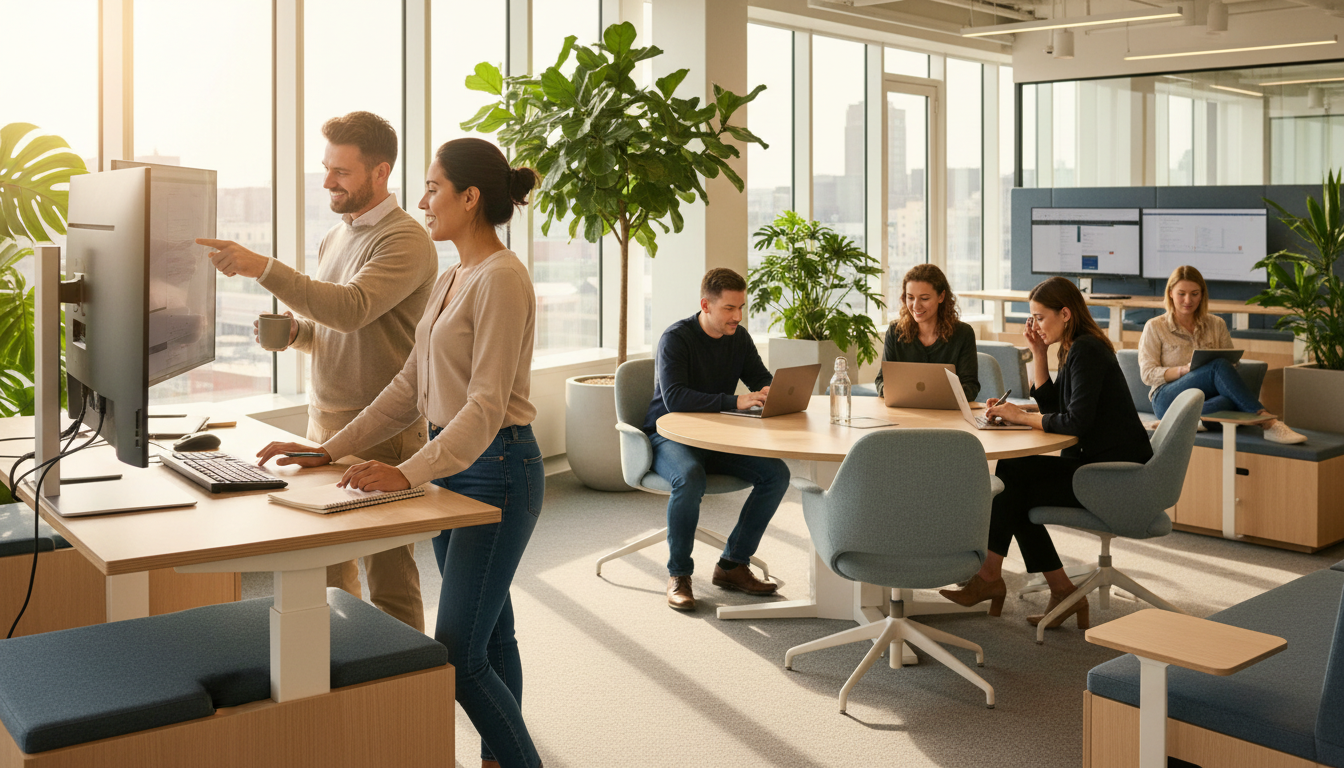
Today, finding the right office space for your teams is a strategic decision that goes far beyond the simple question of square footage. The work environment directly shapes workplace productivity, employee commitment and a company's ability to attract talent. At a time when hybrid working has become the norm, and employees' expectations in terms of well-being at work have undergone profound change, the selection of a workspace deserves particular attention. Executives and office managers who take a methodical approach to this issue gain a measurable competitive advantage. An office designed for its occupants becomes a catalyst for collective performance, a place where ideas flow, where concentration finds its place, where every square meter serves a precise purpose. This quest for the ideal location involves juggling budgetary constraints, team aspirations and anticipating future changes.Corporate real estate now offers a sufficiently wide range of solutions to meet the most varied configurations, from operated offices to shared spaces, via hybrid formulas that combine contractual flexibility and integrated services.
Defining the essential criteria for high-performance workspaces
The search for office space begins with an organizational introspection. Before consulting any advertisements, it's a good idea to establish a precise diagnosis of current uses and foreseeable developments. How many people work simultaneously on site? What activities dominate daily life: frequent meetings, concentrated individual work, video-conferencing calls, receiving visitors? These questions fundamentally influence the type ofoffice layout to be chosen. A nomadic sales team that meets at the office from time to time does not have the same requirements as an accounting department needing calm and confidentiality. Methodical preparation of your search is the cornerstone of a successful approach.
Anticipating future needs weighs just as heavily in the equation. A company planning to recruit ten employees in the next eighteen months needs to factor this projection in from the outset. Opting for a slightly oversized space, or choosing a flexible formula that allows for gradual expansion, avoids hasty moves that are costly in terms of time and energy. The contractual flexibility offered by operated offices responds precisely to this problem: a service contract rather than a rigid lease provides the latitude needed to adapt to the vagaries of growth.
Ergonomics as a pillar of employee comfort
Employee comfort is more than just a declaration of intent in an HR charter. It has a concrete impact on furniture, workstation layout and equipment quality. Professionalergonomics has been the subject of numerous studies demonstrating its direct impact on reducing musculoskeletal disorders and improving concentration. A height-adjustable seat, a screen positioned at the right distance, appropriate lighting: these seemingly insignificant details influence the physical and mental health of teams over the long term.
Companies that invest in ergonomic equipment see a reduction in absenteeism and an increase in job satisfaction. The choice of furniture should be appropriate to the activities carried out: sit-stand desks for sedentary positions, quality armchairs for long working sessions, modular tables for meeting rooms. Renting professional furniture gives you access to top-of-the-range equipment without tying up cash – a particularly appropriate option for structures in a growth phase, or those wishing to test different configurations before making a commitment.
Strategic location at the heart of office selection
A company's address conveys a message. It influences the perception of customers, partners and candidates for recruitment. Office selection necessarily integrates this symbolic dimension, but also very practical considerations linked to accessibility and the living environment offered to teams. A district with good public transport links reduces the stress of the daily commute and broadens the potential recruitment pool. The presence of shops, restaurants and services nearby makes lunch breaks more comfortable, and makes it easier to manage employees' personal constraints.
Certain geographical areas benefit from a particular image that can reinforce a company's positioning. Locating in the Paris CBD is a strategic choice for companies wishing to assert their presence in the economic heart of the capital. Conversely, developing neighborhoods offer more affordable rents and modern, attractive working environments. The trade-off between address prestige and budget optimization depends on each organization's business sector and commercial strategy.
Assess accessibility and surrounding services
Accessibility is measured on several levels. Proximity to metro, streetcar or bus lines is the primary criterion for urban companies. A reasonable travel time from the main residential areas of the metropolis in question facilitates recruitment and limits turnover linked to logistical constraints. For companies receiving visitors or customers, easy access from a train station or airport can be a decisive factor.
The building's immediate surroundings also deserve careful attention. Nearby green spaces offer opportunities for rejuvenating breaks. Walking distance to gyms, crèches and concierge services are also differentiating assets for the employer brand. Some office buildings integrate these services directly, creating complete ecosystems where employees find answers to most of their daily needs without leaving the neighborhood.
Understanding the different types of workspace
Thecommercial real estate market now offers a sufficiently diverse range of solutions to suit every configuration. From traditional offices to flex offices, coworking spaces and operated offices, each formula has its own specific characteristics, which you need to master to make an informed choice. The evolution of workspaces has been accelerating for several years, driven by changes in collaboration patterns and the renewed expectations of new generations of employees.
| Type of space | Benefits | Limits | Adapted profile |
|---|---|---|---|
| Traditional private office | Confidentiality, total customization, complete control | Long-term commitment, high fixed costs | Established companies, confidential activities |
| Office operated | Contractual flexibility, inclusive services, administrative simplicity | Limited personalization according to space | SMEs, ETIs, subsidiaries of major groups |
| Coworking space | Cost control, networking, maximum flexibility | Reduced intimacy, diluted brand identity | Startups, freelancers, project teams |
| Furnished open space | Easier collaboration, optimized floor space | Noise pollution, difficulty concentrating | Creative teams, commercial services |
Operated offices: flexibility and integrated services
The operated office concept meets a growing demand for simplification. A company moving into this type of space benefits from a single point of contact, a global invoice and outsourced management of day-to-day services: reception, cleaning, maintenance, internet connection, coffee and common areas. This formula frees management teams from logistical worries, allowing them to concentrate on their core business. The service contract, often on a monthly or quarterly basis, offers a degree of flexibility that is incompatible with conventional three-, six- or nine-year commercial leases.
Members of an operated space generally have access to high-quality shared infrastructures: fully-equipped meeting rooms, acoustic telephone booths, fully-equipped kitchens, terraces or relaxation areas. This pooling enables us to offer premium services at a lower cost than a traditional rental offering the same services. For growing companies, or those testing out a new geographical market, this approach minimizes financial risk while guaranteeing a quality business environment.
Optimizing layout to boost productivity at work
Office design is an often underestimated performance lever. The layout of workstations, the creation of zones differentiated according to use, acoustic treatment and the management of natural light have a direct influence on team efficiency. A poorly thought-out space generates daily friction: untimely interruptions, difficulties in finding a free room, thermal or acoustic discomfort. Conversely, a well-thought-out layout facilitates interaction, protects moments of concentration and promotes well-being at work.
The current trend is towards functional zoning. The idea is to create spaces dedicated to each type of activity: quiet zones for in-depth individual work, collaborative spaces for creative sessions and informal meetings, acoustic booths for confidential calls or videoconferences. This diversification of ambiences within a single location enables employees to choose the environment best suited to their task at hand, increasing their efficiency and satisfaction.
Creating stimulating collaborative spaces
Acollaborative space is more than just a large table and a few chairs. Its design must encourage spontaneous exchanges while providing the comfort required for extended work sessions. Varied seating, accessible whiteboards, sharing screens and controlled acoustics are the ingredients of a space conducive to collective creativity. The integration of artistic elements also contributes to creating an inspiring atmosphere that stimulates innovation.
Meeting rooms deserve special attention. They need to be sized according to actual use: more and more small rooms for two to four people are often better suited to daily needs than a single large room rarely used to full capacity. Technological equipment, particularly for videoconferencing, is crucial to the efficiency of exchanges with remote employees or external partners. A simple, visible reservation system avoids conflicts of use and optimizes the occupancy rate of these precious spaces.
Taking responsibility into account when choosing office space
Environmental responsibility is now a criterion of choice in its own right. Companies concerned about their carbon footprint prefer premises that meet demanding ecological standards: building energy performance, waste management, second-hand or responsibly sourced furniture. Ecological and responsible offices represent a concrete commitment that resonates with the values of many employees and business partners.
Rehabilitating existing spaces rather than building new ones is part of this virtuous process. Reinvesting disused industrial or commercial premises reduces resource consumption while creating stimulating, atypical working environments. Some office operators have made quantified commitments to reducing their carbon footprint, offering tenant companies the opportunity to integrate this dimension into their own CSR balance sheet. The choice of reconditioned or labelled furniture, the attention paid to consumables and the awareness of occupants to eco-actions complete this global approach.
The collaborative economy applied to professional spaces
The collaborative economy is profoundly transforming the use of office space. The sharing of space between several companies, the pooling of meeting rooms or common equipment, all help to optimize space occupancy rates and reduce individual costs. This approach is part of a logic of use rather than possession, in line with broader societal evolutions.
Sub-letting is an interesting variation on this model. A company with surplus space can make it available to other structures, generating additional income while at the same time bringing its premises to life. Hosting a start-up in your offices creates opportunities for collaboration and mutual enrichment. This practice requires an appropriate legal framework, detailed in the sub-letting manual, which provides security for the parties involved and clarifies the responsibilities of each party.
Budgeting and anticipating real costs
The budget devoted to premises goes beyond the simple amount of the monthly rent. A rigorous financial analysis takes into account all charges: electricity, heating, air conditioning, maintenance of common areas, insurance and various taxes. In a traditional lease, these items are added to the rent and can represent a significant proportion of the total cost. Operated office formulas simplify this equation by offering an all-inclusive pricing package, facilitating budget projection and avoiding unpleasant surprises.
The initial investment also deserves close attention. Fitting out an empty space, purchasing furniture, and installing IT and telephone equipment all represent substantial outlays that put a strain on cash flow at the time of installation. Renting or leasing solutions can smooth out these costs over time, preserving the company's investment capacity for business development. A complete guide to renting office space in Paris details the different options and their financial implications.
Compare offers methodically
Comparing real estate offers requires a structured analysis grid. The price per square metre is a basic indicator, but to be meaningful it must be related to the services included. A seemingly high rent may turn out to be competitive if utilities, reception, cleaning and internet connection are included. On the other hand, an attractive rate may conceal hidden costs that add to the final bill.
The length of the commitment also determines the level of financial risk. A firm six-year lease is best suited to companies whose business and workforce have stabilized. Growing companies, or those operating in volatile sectors, are well advised to opt for more flexible formulas, even if this means accepting a slightly higher unit cost. Seven invaluable tips will help you structure your thinking and avoid common pitfalls.
Supporting teams through the transition
Changing offices is a pivotal moment in the life of an organization. Its success depends as much on the quality of the space chosen as on the way teams are involved in the project. Involving employees in the reflection process, gathering their expectations and concerns, communicating regularly on the progress of the project: these practices facilitate the appropriation of the new premises and reduce resistance to change.
The transition period itself calls for meticulous planning. The logistical organization of the move, the continuity of operations during the changeover phase, and the support given to teams as they discover their new environment all have a bearing on how quickly productivity returns to its nominal level. Some companies organize pre-move visits, distribute practical guides or appoint ambassadors to facilitate the integration of their colleagues. These gestures testify to a managerial culture concerned with well-being in the workplace, and reinforce collective support for the project.
How much floor space is required per employee in adapted offices?
The generally accepted norm is between 10 and 15 square meters per workstation, including circulation spaces and common areas. This ratio varies according to the type of layout chosen: an optimized open space can be as low as 8 square meters, while an enclosed individual office requires more space. The rise of hybrid working changes this equation, since not all employees are present at the same time. A rate of 0.7 to 0.8 workstations per employee is becoming commonplace in organizations practicing flex office.
Operated office or traditional lease: which formula to choose?
The traditional lease is suitable for companies with established needs who wish to fully customize their space. The operated office is for structures that prefer flexibility, administrative simplicity and immediate access to integrated services. The former implies a long-term commitment and direct management of service providers. The latter offers a monthly or quarterly service contract with a single point of contact. The choice depends on the company's stage of development, its visibility on future staffing levels and its ability to manage logistics in-house.
How do you assess the quality of a space before making a commitment?
A physical visit is essential to appreciate the ambience, lighting, acoustics and general condition of the premises. Test the Internet connection, check the operation of common facilities, observe the number of visitors at peak times. Ask current occupants about their day-to-day experience. Examine the building's energy performance and accessibility certifications. Ask for details of utilities and services included to avoid surprises. A trial period, offered by some operators, enables you to validate the compatibility between the space and your actual uses before making any firm commitment.
What are the key criteria for employee well-being?
Natural light is one of the most important factors influencing job satisfaction. Acoustics, which are often overlooked, are a key factor in concentration. Indoor air quality, temperature control and access to break areas all contribute to daily comfort. Ergonomic furniture prevents physical problems linked to a sedentary lifestyle. Local services, accessible green spaces and a varied catering offer complete the picture. Last but not least, employee involvement in the choice and design of their offices reinforces their sense of belonging and commitment.